Longing Suite, Nicolás Grandi & Lata Mani, Video, 28 mins, 2026
Longing Suite is a meditative videopoem that traces the arc of a heart-mind-body awakening to the Feminine Divine and the sacred in all that exists. Grandi and Mani build on a cycle of poems written by Mani in the 1990s to continue their transmedia experiments in kaleidoscopic storytelling. Drawing aesthetic inspiration from the dynamics of the spiritual journey Longing Suite offers an evocative visual and sensorial experience at once individual and universal.
Longing Suite is a visually arresting philosophical dialogue between poetry of words and an activation of an intricate image and sound language. Grande and Mani have created a haptic sensoria of the divine though attentiveness to an intricate assemblage where the taxonomy of unexpected juxtapositions gives rise to a symphony of visceral longing. This seamless poesies is a timely gift of remembrance of the eternal tenderness of humanity, of community and communion with nature. It is an exquisite immersive experience, an evocation of the beauty and necessity for the ineffable at a time of unbearable global horror and destruction. Attune yourself to the reflective frequencies so generously offered and revel in the soul songs of earth amongst the chaos of conflict.
Pratibha Parmar, Feminist Filmmaker & Writer, whose films include Khush, A Place of Rage & My Name is Andrea.
Conversation with Pratibha Parmar on Longing Suite, Video + Transcript: here
In the clear and present danger of these times of genocide and violent degradation and assault on human, more than human life and the environments that sustain it all, the word, sound and visual poems of Longing Suite invite entry into forms of being and living based on the connection of all things. These are poems that facilitate surrender to the divine as act of remembrance and possibility even when all that poses as truth dismembers and desecrates. This is not to confuse the evocation of the blessed and divine with the evacuation of the material and structural but to say that surrender to the infinitude of love as the body expands into its folds of possibility is to engage in a mode of hope as practiced connection against all that would fracture and atomise. Longing Suite is an offering of radical love and potential and necessary balm in these times of war. Its gesture is to foster recognition of longing as bequeathed by the divine in the service of life, earthly and beyond earthly, alike. It calls across the boundaries of false certitude and fantasies of total command and invites entry into the unthought known of infinite becoming. It is a gift to be treasured!
Gail Lewis, Psychoanalytic Psychotherapist. Black Feminist Theorist, Activist & Cultural Critic
“The textured weave of sound and image in Longing Suite leads us to a place that feels like spaciousness and intimacy all at once. This is not a description of sacred longing. It is a distillation of it. Love here is not sentiment, but blessed shipwreck. Desire is not decorative yearning, but desperation, delirium, drowning. Spare and immersive, this film offers us a map of the seeker’s journey. It also offers us the shiver of visceral experience. A swirl of images – implicating geographies both natural and cultural, and metaphors of diverse wisdom traditions – catapults us from faith as inheritance to firsthand encounter. We emerge not as bystanders, but as participants, stained by silence, altered by the windrush and stillness of this wild ride. Nicolás Grandi and Lata Mani’s hauntingly powerful film is both sacred arc and sensorium; pilgrimage and homecoming.”
Arundhathi Subramaniam, poet, writer on the sacred, and author of The Gallery of Upside Down Women & Wild Women: Seekers, Protagonists and Goddesses in Sacred Indian Poetry.
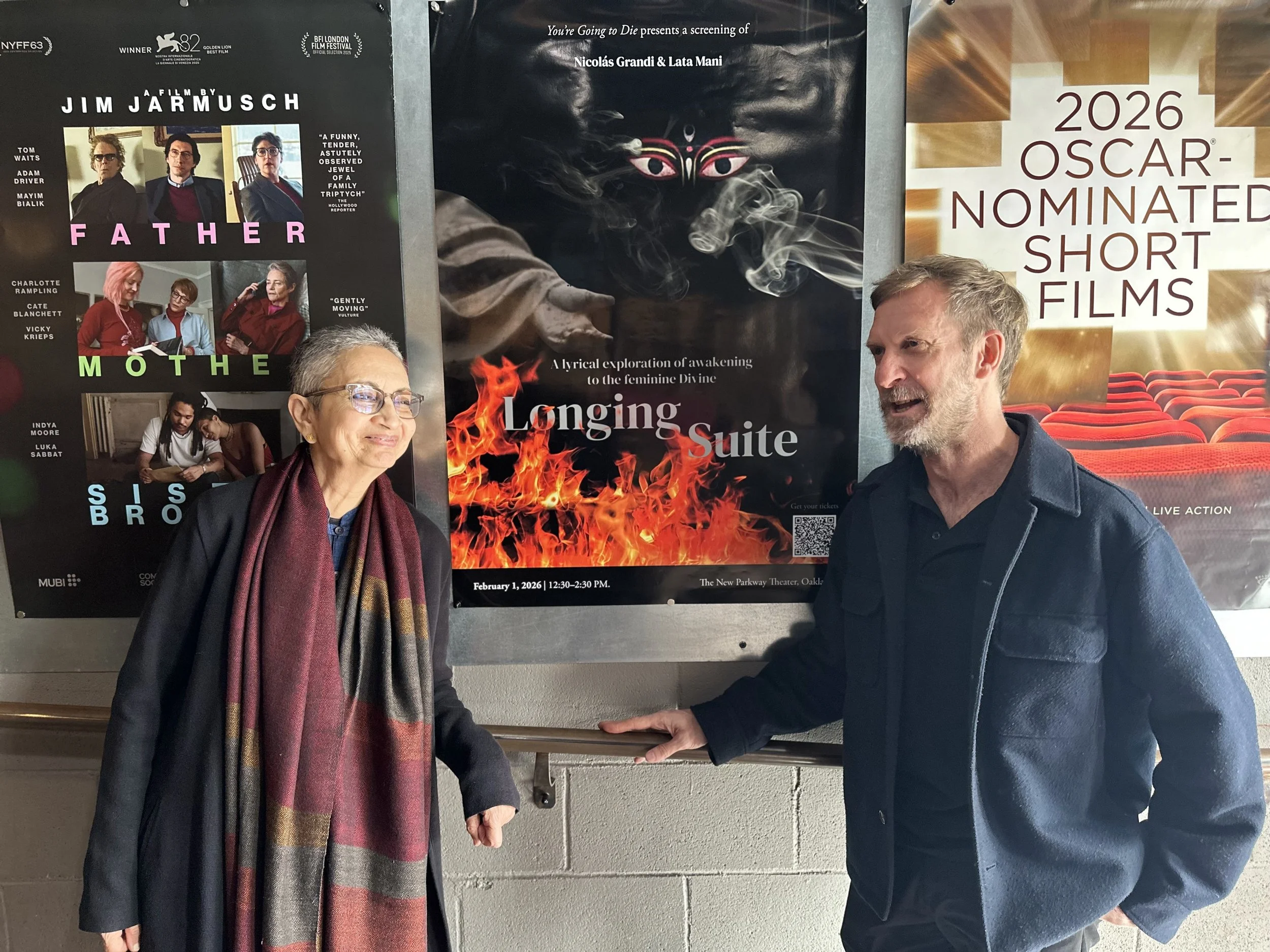
Lata Mani and Nicolás Grandi at Longing Suite premiere in Oakland, CA on February 1, 2026.
Responses to Longing Suite:
Sowmya Ramanathan, “Antidotes to the Buzzy Mind: After Nicolás Grandi and Lata Mani’s Longing Suite”,
Visually, Longing Suite helps us witness meditation with a curious detachment. And as you probably know, meditation is far from static, still, or contained. When I close my eyes to meditate, I see a disturbing simultaneity and multiplicity. I perceive frequent flashes of things I cannot fully grasp. I confront both the partiality and fleetingness of my perception. Thoughts flash before me and circle endlessly. I find this excruciatingly painful.
But Longing Suite teaches us to find beauty in this process. Through a seamless and layered curation of voice, song, ambient noise, photography, and moving image, the film revitalizes our perception. We are face-to-face with the undeniable beauty of a process that is unfolding without revealing its destination. Each carefully pronounced word and curated sound cradles us as we learn to see beauty in nearness and distance, in singularity and multiplicity, in nonhierarchical visuals, in that which is alive. The film’s careful pedagogy seems to suggest that we are held. It suggests that our longing is “fed, clothed, and reared”, if you will, when we learn to notice and feel our connection to the world around us, regardless of outcome.
Read the essay in full, here.
Deeya Gupta: I feel like a glutton. Craving more and more of the film as it draws to an end that I wish never came. Longing Suite, a 28 minute videopoem by Lata Mani and Nicolás Grandi, premiered at the New Parkway Theater, Oakland, on February 1st. The room was packed with family, friends, neighbors, and cinephiles who had all come to see the film and its subsequent artist Q&A. I sat at the back corner of the auditorium, and as the lights dimmed and the film played, I watched as the crowd’s faces reflected the kaleidoscope of colors from the screen, hanging on to each word and drinking in each visual. And I did the same.
I have a short attention span, and a slow meditative experience is the last thing that would capture my attention. And yet, I found myself transfixed by the film in front of me. Video clips of people creating handmade pottery, so entrancing that I could almost feel the clay underneath my fingertips as a former potter. Rolling overlays of gods and coins and an editing style that always had something new and fresh for your eyes to take in.
I met Lata Mani for the first time an unknown number of years ago. All I know is that I don’t remember a moment in my life when I didn’t know her. Where I couldn’t taste her homemade khichdi on my tongue or the heat of spicy chips that can only be found in India, or feel the comfort of curling up in her armchair, one that still makes me feel small over 20 years later.
It was in her apartment in Oakland that I first saw the beginnings of the film’s production. Audio snippets of poems being read and choruses of songs, an image here, a video clip of the ocean there, all stored in one google drive folder and being shown, so charitably, to little old me. The film follows Lata’s journey, post-accident, as the Feminine Divine is awakened in her mind, body, and soul. Over the years Lata, or rather Lata Aunty, and I have talked in great depth about our place in the universe. About happiness and sadness and hardship and how living with each teaches us about ourselves, others, and the universe that we are a part of.
I would love to talk about each poem’s prose, each image’s meaning, and each shot’s emotion, but to do so would be the biggest disservice to the audience. This is a film you need to hear and see and touch and let it touch you, this is a film you need to feel. You need to go in without preconceptions and allow your life experiences and Lata’s life experiences to connect and dance with each other.
I initially worried that the Q&A session would take away from this. That once the song was explained, the audience would think “Oh this is how I am supposed to view the film, this is how I am supposed to dance”. But Lata and Nicolás answered each question with such careful thought, never confining the work, and instead allowing the dance to continue while enriching the moments when the partners came into sync with even greater meaning and intensity. To see this film take its first steps to running on the big screen is both an honor and a privilege. To anyone who is thinking about watching this film, I strongly encourage you to do so. It’s a film that invites you in gently and leaves you changed. And to Lata and Nicolás, thank you for your vision and your courage. For creating a piece of art so beautiful that it stays with you long after the screen fades to black.
Deeya Gupta is a San Francisco based cinephile and journalist.
Quisque iaculis facilisis lacinia. Mauris euismod pellentesque tellus sit amet mollis.